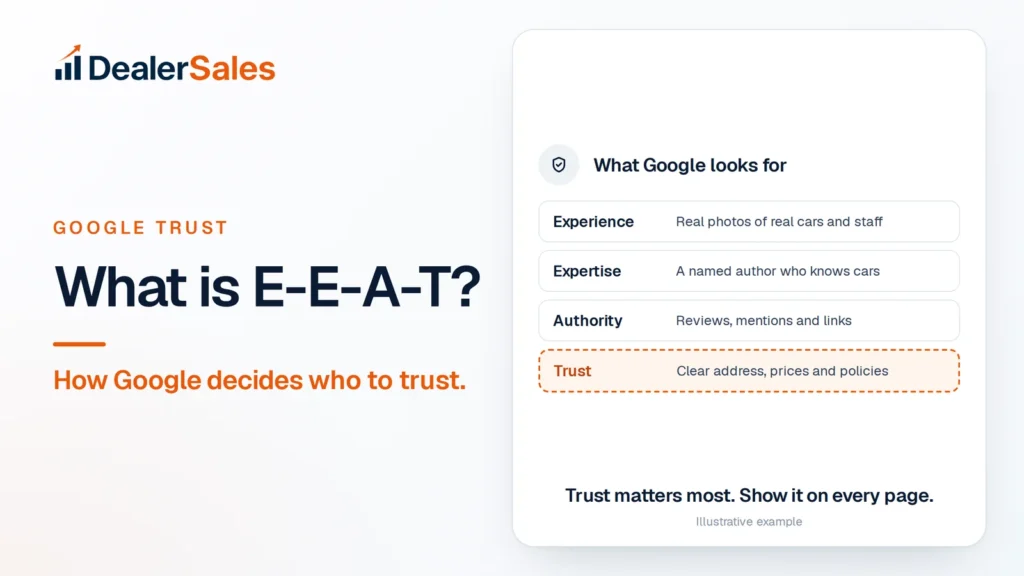
Short answer: E-E-A-T stands for Experience, Expertise, Authoritativeness and Trustworthiness, the qualities Google’s quality raters use to judge whether a page deserves trust, and Google says trust matters most. It is not a direct ranking factor, but dealers who show real cars, real people, clear prices and honest reviews give Google more reasons to trust them.
What each letter means for a dealership
Google’s definitions are general. Here is what each one looks like on a used car lot.
| Letter | Google’s idea | What it looks like for a dealer |
|---|---|---|
| Experience | First-hand experience with the topic | Your own photos of the actual car, test-drive notes, recon work you did |
| Expertise | Knowledge and skill | Guides written by a named person who has sold or serviced cars for years |
| Authoritativeness | Being a go-to source | Reviews, local press, links and mentions from other sites |
| Trustworthiness | Accurate, honest, safe | Real address, clear prices and fees, return and warranty terms, secure forms |
Google puts it plainly in its guide to helpful content: of these four, trust is most important. The other three contribute to trust.
Where E-E-A-T comes from, and what it is not
E-E-A-T comes from Google’s Search Quality Rater Guidelines. Raters are people who tell Google whether its results look helpful. Their ratings help Google test its systems. They do not move your rankings directly.
Google added the first “E,” for Experience, in December 2022. The idea: someone who has actually used a product often knows more than someone who has only read about it.
Two things to get right:
- E-E-A-T is not a single ranking factor. Google says so. There is no E-E-A-T score you can check.
- Google does look for signals that line up with it. Its systems use a mix of factors that can identify content with good E-E-A-T.
So you cannot “add E-E-A-T” with a plugin. You show it, page by page.
Why dealers are held to a higher bar
Google gives even more weight to strong E-E-A-T on topics that could affect people’s health, financial stability or safety. It calls these “Your Money or Your Life” topics.
A car is one of the biggest purchases most families make, often with a loan attached. Your finance, credit and warranty pages touch money directly. It is fair to assume those pages face a higher bar than a blog post about the best road-trip snacks.
7 ways a dealership website shows E-E-A-T
1. Real photos of the real car
Shoot 30 to 40 photos of each car on your lot, including the odometer, tires and any scratches. Stock images tell Google and buyers nothing. Your own photos prove the car exists and you have seen it.
2. A named author on every guide
Put a byline on each buyer’s guide: “By [Name], used car manager, 14 years in the business.” Link it to a short bio page with a photo. Google’s helpful content guide asks whether it is clear who created the content.
3. Inspection and recon details
Say what you did to the car. Here is the difference on one listing:
- Before: “2018 Toyota RAV4. Great condition. Must see. Call today.”
- After: “2018 Toyota RAV4 XLE, 71,000 miles, $19,990. One owner, clean title. Passed our 150-point inspection. We replaced the front brake pads and two tires, and the rear hatch strut. Service records on file since 30,000 miles.”
The first version could describe any car on any lot. The second shows someone actually worked on this one. That is experience and expertise in a few lines, and it gives an AI tool real facts to quote. Only list work you actually did.
4. Clear prices and fees
“Call for price” hurts trust. Show the price, and list any dealer fees or doc fees on the page or on a linked fees page. A buyer who finds a surprise $899 fee at signing will say so in a review.
5. The same name, address and phone everywhere
Your footer, Google Business Profile, Bing, Apple Maps, Facebook and every listing site should match exactly. Put your dealer license number in the footer if your state or territory issues one. See our NAP consistency guide for the one-hour check.
6. Reviews shown and answered
Link to your Google reviews, and reply to every one, good and bad. A calm, specific reply to a one-star review builds more trust than ten unanswered five-stars. For targets, read how many Google reviews a dealership needs.
7. Policies a buyer can find in one click
Return policy, warranty options, privacy policy, finance disclosures and an “About us” page with real staff photos. Google’s guidance points to author pages and About pages as ways to show who stands behind the content.
A 15-minute E-E-A-T check
Open your site on your phone and score it.
| Check | Where to look | Pass if |
|---|---|---|
| Real photos | 3 random car pages | No stock images, 20+ photos each |
| Price shown | Same 3 pages | A number, not “call” |
| Fees disclosed | Car page or fees page | Found in under 2 clicks |
| Author named | Your blog or guides | Name, role and bio link |
| Address and phone | Footer | Matches Google Business Profile exactly |
| Reviews | Homepage or reviews page | Recent, with owner replies |
| Policies | Footer links | Return, warranty, privacy all present |
Five or more passes is a solid start. Under four, fix those before you write another page.
How E-E-A-T carries into AI answers
Google’s guide to generative AI search says the same SEO basics apply to AI Overviews and AI Mode. So the trust work you do for regular search also helps with Google’s AI answers.
Other AI tools do not publish E-E-A-T rules, but they face the same problem: which dealer can they safely name? Real reviews, consistent facts and helpful guides make that choice easier. Our GEO vs AEO vs AIO vs SEO guide covers the rest.
Proof: An Australian dealer’s buyer’s guides drove 264,000 impressions in Google AI Overviews and AI Mode in 90 days, and organic visits grew from about 500 to over 5,500 a month. See the numbers.
Mistakes that cost dealers trust
- Fake or bought reviews. Google’s review policies prohibit them, and buyers spot them.
- AI-written guides with no name on them. If no one will sign it, why should Google trust it?
- Old inventory left online. A sold car still listed at $15,990 is a broken promise.
- Different hours on every site. Buyers who drive over on a Sunday and find you closed do not come back.
What to do next
Run the 15-minute check above and fix the cheapest failures first: prices, footer details and author names. Then see how often AI tools already name you. Our free score tests 20 buyer questions in your market.
Quick answers
Is E-E-A-T a Google ranking factor?
Not directly. Google says E-E-A-T itself is not a specific ranking factor, but its systems use a mix of signals that line up with it.
What is the most important part of E-E-A-T?
Trust. Google says trust is the most important of the four, and the other three contribute to it.
How can a small dealership show expertise?
Put a named person with real years in the business on your buyer’s guides, with a short bio. Add details only someone who handled the car would know.
Sources
- Creating Helpful, Reliable, People-First Content (Google Search Central)
- E-E-A-T and major updates to Google’s quality rater guidelines (Search Engine Land)
- Google’s Guide to Optimizing for Generative AI Features on Google Search (Google Search Central)
Get my AI visibility score
We ask ChatGPT, Perplexity, Gemini and Google AI 20 buyer questions about your market and score how often you are named. Free, no sales call.