Short answer: SGE (Search Generative Experience) was Google’s 2023 test of AI answers in Search, and it became AI Overviews in May 2024, so “SGE content” now means pages written for AI Overviews and AI Mode. For a dealer, that is a page that answers one buyer question in its first two sentences and adds facts only your store has.
SGE in one paragraph
SGE stood for Search Generative Experience. Google announced it on May 10, 2023 as an opt-in experiment in Search Labs, first in the US and in English only. It put an AI-written snapshot at the top of results, with links to the pages it used.
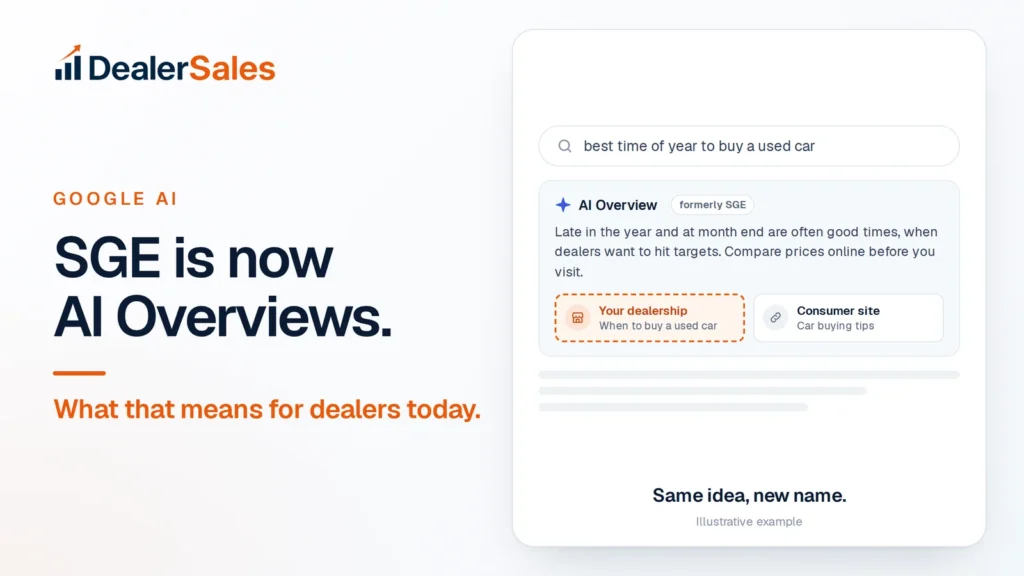
A year later it graduated. On May 14, 2024, Google started rolling out AI Overviews to everyone in the US. Same idea, new name, no sign-up.
So if an agency, a plugin or a forum post tells you to do “SGE optimization”, they mean AI Overviews. Nothing called SGE runs in Google today.
The timeline, from test to everyday search
| Date | What happened |
|---|---|
| May 2023 | SGE launched as a Search Labs experiment in the US |
| May 2024 | Renamed AI Overviews and rolled out to everyone in the US |
| March 2025 | AI Mode, a chat-style search, opened as a Labs experiment |
| May 2025 | AI Mode rolled out to everyone in the US |
| Aug–Oct 2025 | AI Mode expanded to over 200 countries and territories |
| 2026 | Search Console added a Generative AI performance report |
The point for a dealer: this is no longer a test. Your buyers see AI answers on everyday car questions, in the US and in Australia.
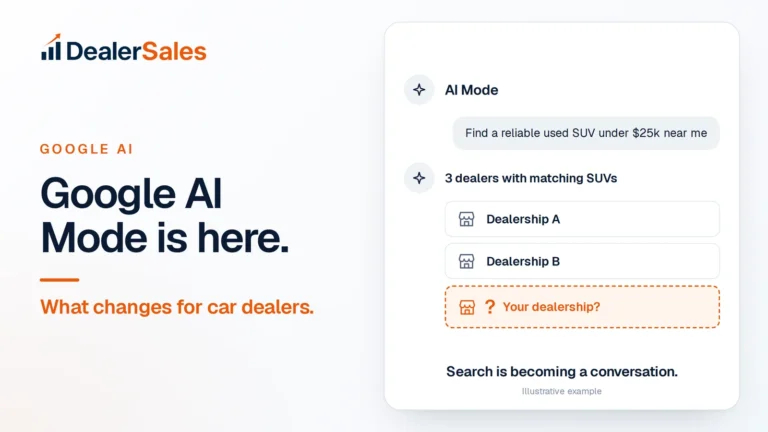
AI Mode matters here too. It is the longer, chat-style version, where a buyer can ask a follow-up like “which of those dealers is open Sunday?” The same pages feed both. Google says both features pull from pages that are indexed and eligible for a snippet, so one set of good pages covers both. More on AI Mode for dealers.
What “SGE content” means today
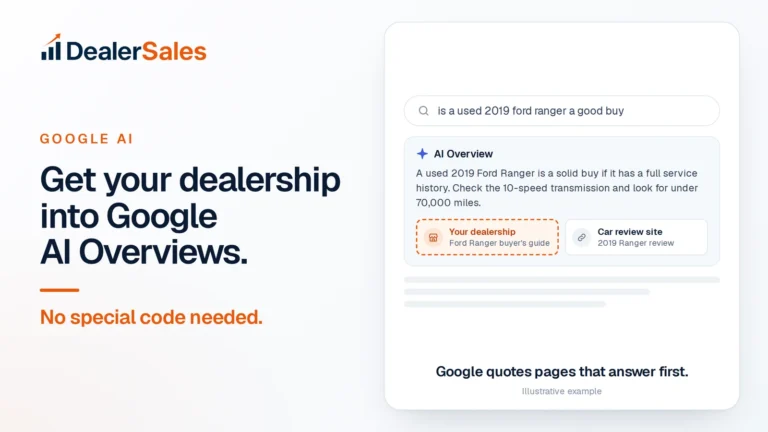
Strip out the jargon and “SGE content” means one thing: a page Google’s AI can quote.
Google says there is no special code for this. A page must be indexed and eligible to show with a snippet in normal Search. No new files, no AI text files, no special schema. The full checklist is here.
What decides whether your page gets picked is the writing. Google’s own guidance asks for content that is original, useful and based on real experience, and warns against repeating what the rest of the internet already says.
If you are also hearing GEO, AEO and AIO, they overlap heavily with this. Here is how they compare.
Old SGE advice: what still holds and what to drop
A lot of 2023 advice was guesswork during a test. Here is how it looks now that Google has published guidance.
| 2023 SGE advice | Status today |
|---|---|
| Answer the question in the first lines | Still true. It makes the page easy to quote. |
| Add special AI schema or markup | Drop it. Google says none is needed. |
| Create an llms.txt file for Google | Drop it for Google. Google Search ignores it. |
| Break every page into tiny chunks | Drop it. Google says no chunking is required. |
| Show first-hand experience | Still true. It is what sets your page apart. |
| Keep Google Business Profile complete | Still true. Google says it helps local businesses in AI answers. |
How to write a page Google’s AI quotes
Take the question in the image above: “best time of year to buy a used car”. Most sites answer it with the same generic list. Here is how a dealer page wins it.
- Put the exact question in the H1 or first heading. “When is the best time to buy a used car in [city]?”
- Answer in the first two sentences. “In our experience, the last week of the month and the end of the year are often good times, because dealers are working toward targets. Compare prices online before you visit.” Write what is actually true on your lot, not what every other site says.
- Add what only you know. How your own lot changes through the year. When trade-ins peak. When you usually have the most SUVs in stock.
- Give a real example. “Last December we had 14 mid-size SUVs on the lot, against a usual 8. A 2020 Honda CR-V EX with 61,000 miles at $22,990 sat for 19 days.”
- Close with the next step. Link to in-stock SUVs and your trade-in page.
Only use numbers from your own records in step 4. The example above is illustrative. Yours should be real.
The two-sentence test
Read only the first two sentences of the page. If a buyer could stop there and have a useful answer, the page passes. If those sentences are “Welcome to Your Dealership” and “We have been serving [city] since 1998”, it fails.
Five page types that work for dealers
- Buyer’s guides for models you stock: “Is a used 2019 Toyota RAV4 a good buy?” How to write one.
- Financing explainers: “Can I buy a car with a 560 credit score in [city]?”
- Trade-in guides: “How we value your trade, step by step.”
- Timing and process pages: “What documents do I need to buy a car in [state]?”
- Comparison pages: “Used RAV4 vs CR-V: which holds up better at 80,000 miles?”
Each one answers a question a real buyer typed. Each one ends with cars you actually have.
Proof: One Australian dealer’s pages were shown 264,000 times in Google AI Overviews and AI Mode in 90 days, and its top eight AI pages were all buyer’s guides. See the numbers.
Mistakes dealers make with “SGE content”
- Buying an “SGE package”. If someone sells SGE markup or SGE files, ask what Google document says they are needed. There is none.
- Publishing 50 AI-written posts in a week. Google says generic content that a generative AI model could easily produce gives it little reason to pick your page.
- Hiding the answer. Sliders, pop-ups and “Why choose us” blocks above the answer push it down the page.
- Blocking snippets. A
nosnippetormax-snippet:0tag keeps a page out of AI Overviews. Check your theme and SEO plugin. - Forgetting to measure. Search Console’s Generative AI performance report shows how often links to your pages appear in AI Overviews and AI Mode.
What to do next
Pick the three questions your sales team hears most and rewrite one page for each so the answer sits in the first two sentences. Then check the Generative AI report in Search Console once a month for 90 days. If you want to see where you stand now, get your AI visibility score below.
Quick answers
Is SGE still a thing?
No. SGE was the Search Labs test name from 2023. It became AI Overviews in May 2024, and Google added AI Mode in 2025.
What is the difference between SGE and AI Overviews?
They are the same feature at different stages. SGE was the opt-in experiment, and AI Overviews is the version shown to everyone in Google Search.
Do I need special code for SGE or AI Overviews?
No. Google says a page only needs to be indexed and eligible to show a snippet. There is no special markup, schema or AI file to add.
Sources
- How Google is improving Search with generative AI (Google, May 2023)
- Generative AI in Search: Let Google do the searching for you (Google, May 2024)
- AI features and your website (Google Search Central)
- Optimizing your website for generative AI features on Google Search (Google)
Get my AI visibility score
We ask ChatGPT, Perplexity, Gemini and Google AI 20 buyer questions about your market and score how often you are named. Free, no sales call.