Short answer: A buyer’s guide answers one question about one model you stock, like “Is a used 2019 Toyota RAV4 a good buy?”, with what to check, a fair price and the cars on your lot. It wins in Google AI because it answers the exact question buyers type and adds first-hand detail no marketplace listing has.
Why this page type wins
Most dealer blogs post “5 tips for buying a used car”. So does everyone else. Google has thousands of those and no reason to pick yours.
A buyer’s guide is different. It answers one question about one model, from a store that inspects, prices and sells that model every week. That is the kind of page Google’s own guidance asks for: original, useful and based on first-hand experience.
Proof: One Australian dealer reached 264,000 impressions in Google AI Overviews and AI Mode in 90 days, and its top eight AI pages were all buyer’s guides we wrote. See the numbers.
Not one of those eight was a home page, an inventory page or a “why choose us” page.
What a buyer’s guide page is (and is not)
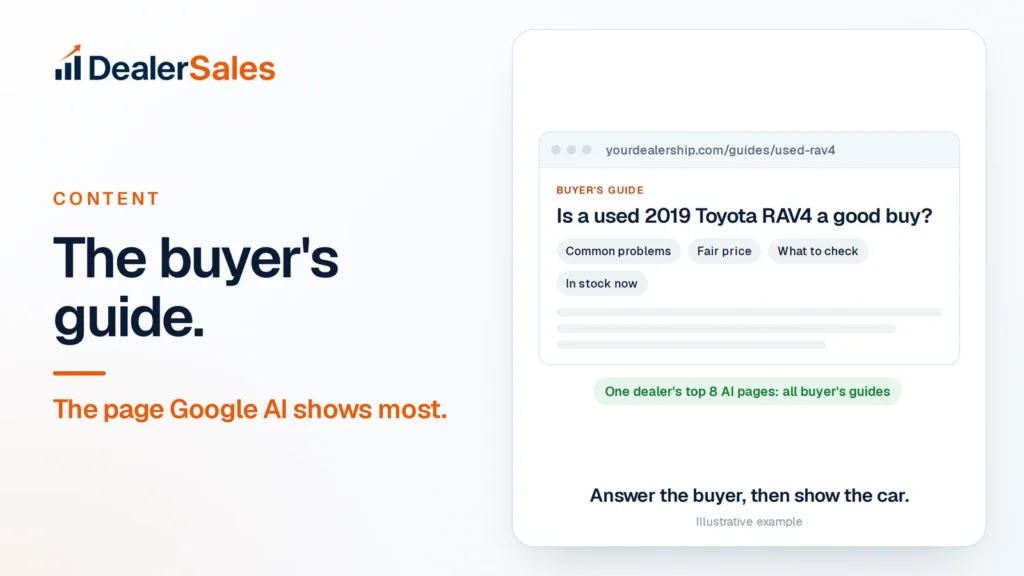
It is a page like “Is a used 2019 Toyota RAV4 a good buy?” It has four parts, the same four you see in the image above:
- Common problems buyers ask about for that model and year
- Fair price for that model in your market
- What to check before buying, including what your shop checks
- In stock now, with your matching cars
It is not the FTC Buyers Guide. In the US, the Used Car Rule requires a Buyers Guide sticker on every used car you offer, showing whether it is sold “as is” or with a warranty. Keep doing that. This article is about a web page that happens to share the name.
Which models to write first
Do not start with the car you like. Start with your sales data.
| Pick models that… | Why |
|---|---|
| You sell most often | You will keep having stock to link to |
| You have 5+ of right now | The “in stock” section is full on day one |
| Your team gets asked about most | Buyers are already typing those questions |
| Have a known question attached | “Is the CVT okay?” is a page waiting to be written |
| Sell well in your area | Trucks in rural Texas, utes like the Hilux and Ranger in Queensland |
Write ten guides for ten models. Then add one or two a month.
The template: 8 sections, in this order
- H1 as a question. “Is a used 2019 Toyota RAV4 a good buy?”
- Two-sentence answer. Yes, no, or “yes, if”. This is the part Google’s AI quotes.
- Who it suits. Commuters, small families, towing, first car.
- Common problems and questions. What owners and buyers raise for this model and year, in plain words.
- What to check. A short checklist a buyer can take to any lot, including yours.
- Fair price. A price range for your market by mileage band, and where you got it.
- How it compares. One or two rivals, like the Honda CR-V and Mazda CX-5, in a short table.
- In stock now. Your matching cars with year, trim, mileage and price as text, each linking to its vehicle page.
Aim for 900 to 1,500 words. Long enough to be useful, short enough to read on a phone.
Example: the first 150 words
Here is how the top of a RAV4 guide could read. Every number is illustrative. Use your own.
Is a used 2019 Toyota RAV4 a good buy?
“For most buyers, yes, if it has a full service history and a clean recall check. In [city], expect to pay about $21,000 to $26,000 for one with 50,000 to 80,000 miles, depending on trim and condition.”
“We have sold 23 RAV4s from this generation in the last year. Before any goes on our lot, our technician checks the service history, runs the VIN through the NHTSA recall lookup, and road-tests it on the highway and in stop-start traffic.”
“Right now we have a 2019 RAV4 XLE with 61,400 miles at $23,990.”
Notice what the opening does. It answers, gives a price range, proves first-hand experience, and shows a real car.
Keep reliability claims honest
Do not invent common faults to sound expert. Use three sources:
- Your own shop. What your technicians actually find on this model. That is the part no other site has.
- NHTSA. Search recalls and complaints by year, make and model, and tell buyers to check the specific VIN.
- Owner and review sources you can link to. Google’s own review guidance asks for links to useful resources.
If you are not sure a problem is common, say “some owners report” and link to where. Or leave it out.
How to write the fair price section
Buyers want a number. Give them a range, not a quote.
| Mileage | Fair price in [city] (example) |
|---|---|
| Under 50,000 | $24,500–$27,000 |
| 50,000–80,000 | $21,000–$25,500 |
| 80,000–110,000 | $18,000–$22,000 |
Build it from your own sales, your local listings on Cars.com, CarGurus or AutoTrader (Carsales in Australia), and a pricing guide. Write down the month you checked. Update it every 90 days.
How to keep the “in stock now” section working
This section turns a reader into a lead. Keep it simple.
- Show 3 to 6 matching cars, each with year, trim, mileage and price as text, and a link to its vehicle page. Here is what those pages need.
- Update it weekly from your inventory feed or by hand. A guide that lists sold cars loses trust fast.
- When you have none in stock, say so and offer a way to be told when one arrives, or show the closest rival you do have.
This also answers the follow-up buyers ask in Google AI Mode: “Who has one near me?” More on AI Mode.
Mistakes that kill a buyer’s guide
- Selling in the first paragraph. “Come see our huge range of RAV4s” is not an answer. Answer first, show the cars last.
- One template for every model. Swapping the model name into the same page is the generic content Google passes over.
- Deleting the page when the car sells. The guide keeps working. Update the in-stock list instead.
- Price as an image. Google’s AI cannot quote it. Write prices as text.
- No author or date. Name the person who wrote it, like your service manager, and show when it was last updated.
For the technical side, Google needs the page indexed and able to show a snippet. The full checklist is here.
What to do next
Pull your top ten models by units sold in the last year and write the first guide this week, using the eight-section template. Check it in Search Console’s Generative AI report after 90 days. If you want to see how Dealer Sales plans, writes and tracks guides like the ones in the case study, book the walkthrough below.
Quick answers
What should a car dealer blog about?
Buyer’s guides for the models you stock, financing explainers and trade-in guides. Each should answer one buyer question and end with the cars you have in stock.
How long should a used car buyer’s guide be?
Around 900 to 1,500 words. Put the answer in the first two sentences, then add what to check, a fair price range and your in-stock cars.
Can I use AI to write buyer’s guides?
You can use it for a first draft, but the value is what only you know: what your shop finds, your local prices and your stock. Google says content that just repeats what is already online gives it little reason to pick your page.
Sources
- Optimizing your website for generative AI features on Google Search (Google)
- Write high quality reviews (Google Search Central)
- Check for Recalls (NHTSA)
- Dealer’s Guide to the Used Car Rule (FTC)
See the AI Growth Plan in 15 minutes
A 15-minute walkthrough with real numbers from dealers like you. No pressure.