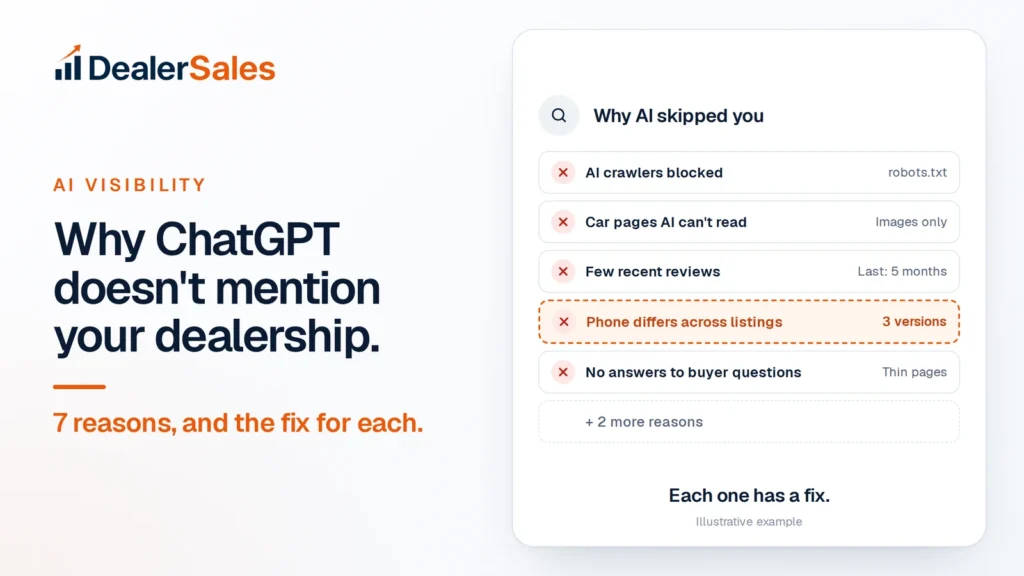
Short answer: ChatGPT skips a dealership when it cannot read the website or finds thin, stale or conflicting information about it. The seven usual causes are blocked crawlers, image-only car pages, few recent reviews, mismatched phone numbers, thin pages, a weak Bing presence and no local mentions, and each one has a simple fix.
First, confirm you are actually missing
Before you fix anything, ask ChatGPT four buyer questions in a private window, such as “best used car dealer in [city]” and “where can I buy a used F-150 under $30,000 near [city].” Count how often your store is named. Here is the full 2-minute check.
If you are named in zero or one answer, one or more of the reasons below is almost always the cause. They are in order: fix the first ones first, because nothing later on the list works if AI cannot read your site.
1. AI crawlers are blocked in robots.txt
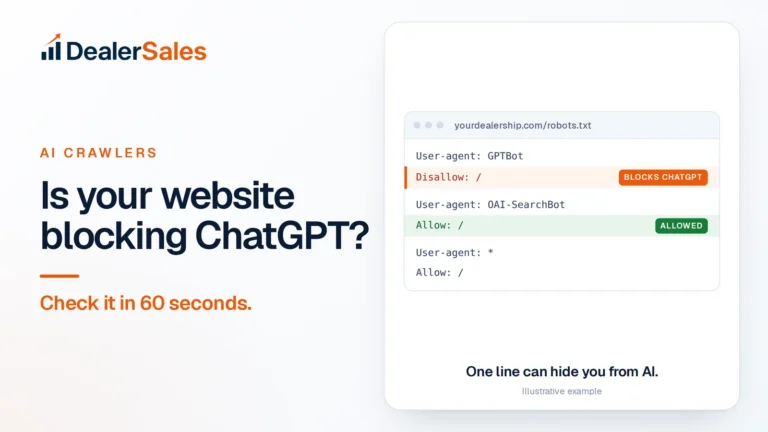
The problem. A file on your site called robots.txt tells bots what they may read. If it says Disallow: / for OAI-SearchBot, or for every bot, ChatGPT search cannot read your pages. OpenAI says sites that block OAI-SearchBot will not be shown in ChatGPT search answers, only as bare navigation links.
This often happens by accident. A developer copies a “block AI” rule from a blog post, or a security service blocks bots at the firewall before they ever see robots.txt.
The fix.
- Open yourdealership.com/robots.txt in a browser.
- Look for OAI-SearchBot, ChatGPT-User, PerplexityBot or
User-agent: *followed byDisallow: /. - Remove those blocks, or add
Allow: /for the search bots. - Ask your host whether a firewall or “AI bot” setting is also blocking them.
OpenAI says robots.txt changes take about 24 hours to take effect. Here is the full test for whether your website is blocking ChatGPT.
2. Your car pages are images only
The problem. Many dealer sites show price and mileage as a graphic, a window-sticker image or a script that loads after the page opens. A person sees “$31,990.” A bot sees nothing.
Vercel studied AI crawler traffic across its network and found that none of the major AI crawlers it tracked, including OpenAI’s and Perplexity’s, ran JavaScript. They read the raw page. If the price is not in that raw text, the car is invisible to them.
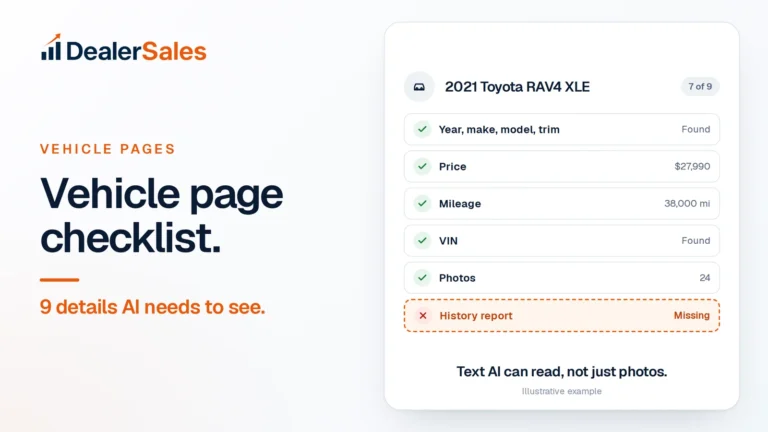
The fix. Every vehicle page needs these facts in plain text:
- Year, make, model and trim: “2019 Ford F-150 XLT SuperCrew”
- Price: “$31,990”
- Mileage: “64,000 miles”
- Engine, drivetrain and color
- Stock number or VIN, and your city
Quick test: open a car page, press Ctrl+F and search for the price. If the browser cannot find it, neither can AI.
3. Few recent reviews
The problem. Your last Google review was five months ago. To a buyer, and to an AI reading your profile, that looks like a store that went quiet. Google itself says more reviews and positive ratings can help a business’s local ranking.
The fix. Ask every buyer, at delivery, while they are happy. Send a text before they leave the lot:
“Thanks for choosing us for your 2021 Toyota RAV4 today. Would you leave a quick Google review? It helps a local business a lot. [link]”
Aim for a steady flow every week, not a burst every quarter. Reply to every review, good or bad, with a short, specific answer.
4. Your phone number differs across listings
The problem. Your website says 555-0123. Google says 555-0147, the old number. Facebook shows a call-tracking number, 555-0199. That is three versions of one business.
When sources disagree, AI has no way to know which one is right. And if it repeats the old number, the buyer who calls a dead line does not call twice.
The fix. Pick one name, one address and one main phone number. Then check and correct every place you appear:
| Listing | What to check |
|---|---|
| Website header and footer | Name, address, phone |
| Google Business Profile | Name, address, phone, hours |
| Bing Places | Same as Google |
| Facebook page | “About” section |
| Cars.com, CarGurus, AutoTrader (Carsales in AU) | Dealer profile |
| Yelp, DealerRater, BBB | Business details |
If you use call tracking, keep your main number as the primary number on listings. Here is how to make your name, address and phone consistent everywhere.
5. Your pages do not answer buyer questions
The problem. Your site has a homepage, an inventory page and a contact form. That is it. When a buyer asks “which dealers in [city] help with bad credit,” ChatGPT looks for a page that answers that. You do not have one, so you are not in the answer.
The fix. Write one page for each question your salespeople hear every week. Start with these five:
- Can I buy a car with bad credit at Your Dealership?
- How do you value my trade-in?
- What does your inspection cover?
- Do you buy cars for cash, even if I do not buy from you?
- What is the best used SUV under $20,000 for a family?
Put the answer in the first two sentences, then explain. Plain words, real numbers, your city name.
6. You are weak in Bing
The problem. OpenAI says ChatGPT sends search queries to third-party search providers and names Microsoft as one of them. If your site is not properly indexed in Bing, you are starting behind.
The fix.
- Set up Bing Webmaster Tools and submit your sitemap.
- Claim your listing in Bing Places, with the same details as Google.
- Search Bing for your store name and your top models plus your city. If your car pages do not show, find out why.
7. Nobody else mentions you
The problem. A BrightLocal study of 800 local business searches in late 2024 found that, beyond business websites, ChatGPT cited articles, blogs and reference pages that mention businesses (27% of sources) and directories (15%). If no local site ever mentions your store, you are missing that part of the picture.
The fix. Earn a few real local mentions: your chamber of commerce listing, a sponsorship page, a local news story, a community event. Make sure each one uses your exact name and city. A handful of genuine local pages beats a pile of junk directories.
Proof: A brand-new Brisbane dealer website, launched with no history, reached 2,311 Google search clicks and 5,260 Google AI Overview impressions in its first 90 days. See the numbers.
What to do next
Work through the list in order and recheck the same ChatGPT questions each month. Most dealers find two or three of these at once. If you want them found for you, the free audit below checks all seven and ranks what to fix first.
Quick answers
Why does ChatGPT recommend my competitor and not me?
Usually because the competitor’s website is easier to read and its details match everywhere. Check your robots.txt, your car pages and your phone number across listings first.
Can I pay ChatGPT to recommend my dealership?
No. You can buy ChatGPT ads, but OpenAI says ads do not influence the answers. Getting named in the answer comes from your website and listings.
How long after fixing these will ChatGPT mention my dealership?
Robots.txt changes take about 24 hours to register with OpenAI. Reviews, listings and new pages usually take weeks to a few months to show up in answers.
Sources
- Overview of OpenAI crawlers (OpenAI)
- Searching the web with ChatGPT (OpenAI Help Center)
- The rise of the AI crawler (Vercel)
- Tips to improve your local ranking on Google (Google Business Profile Help)
- Uncovering ChatGPT search sources (BrightLocal)
Get my AI visibility score
We ask ChatGPT, Perplexity, Gemini and Google AI 20 buyer questions about your market and score how often you are named. Free, no sales call.