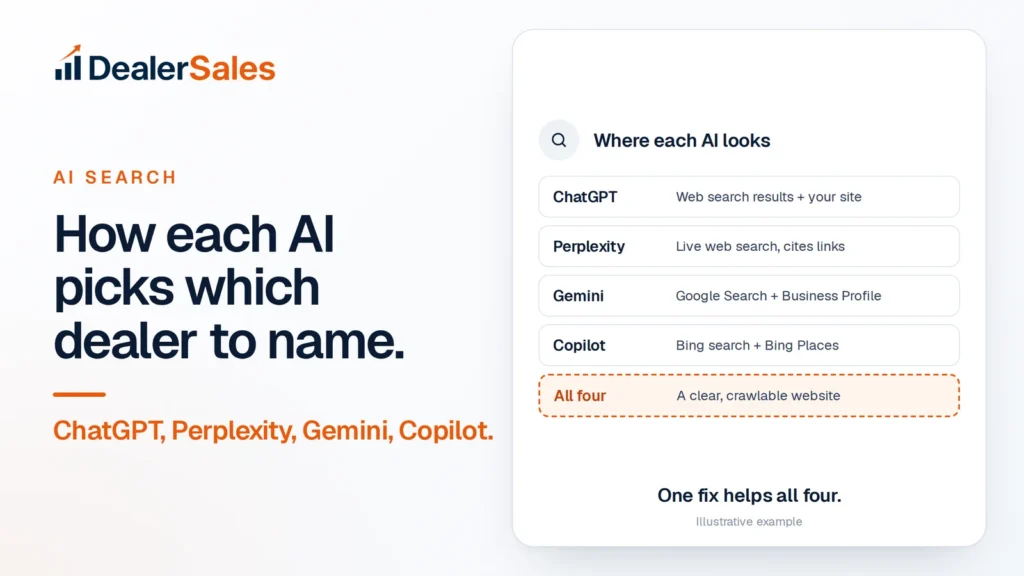
Short answer: ChatGPT searches through partners including Microsoft plus its own crawler, Copilot uses Bing, Perplexity runs live searches with citations, and Gemini draws on Google Search and Google Maps. All four read your website, so a clear, crawlable site with matching Google and Bing listings helps in every one.
The one-table version
None of these tools keeps a private list of “approved” dealers. When a buyer asks “where should I buy a used truck in [city],” each one searches, reads a handful of pages and writes an answer. What differs is where it searches.
| AI tool | Where it looks | What it needs from you |
|---|---|---|
| ChatGPT | Third-party search providers, including Microsoft, plus its own crawler | A site OAI-SearchBot can read; a strong Bing presence |
| Perplexity | Live web search with its own crawler, with numbered citations | A site PerplexityBot can read; pages worth citing |
| Gemini | The Google Search index, plus public Google Maps data for places | Indexed pages; a complete Google Business Profile |
| Copilot | The Bing search service | Pages Bing has indexed; an up-to-date Bing Places listing |
| All four | Your website | Clear, crawlable text that answers buyer questions |
Now the detail, one tool at a time.
ChatGPT: web search partners plus its own crawler
OpenAI says ChatGPT rewrites a buyer’s question into one or more search queries and sends them to third-party search providers. Its help page names Microsoft as one of those partners. It also says ChatGPT may use an approximate location from the user’s IP address to give local results.
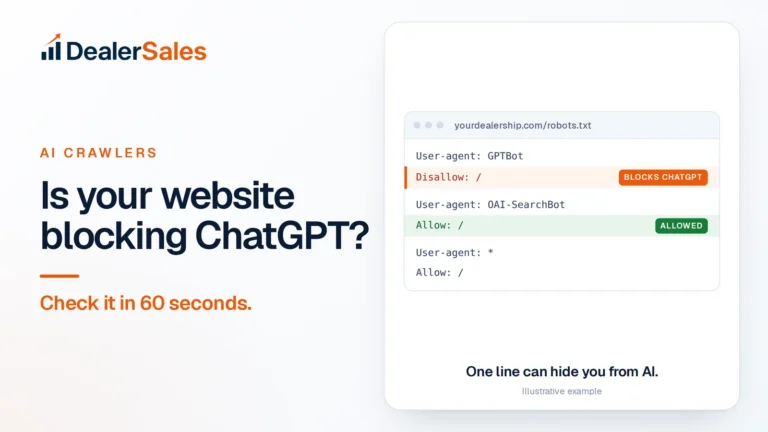
ChatGPT also has its own crawler, OAI-SearchBot. OpenAI tells site owners who want to appear in ChatGPT search to allow OAI-SearchBot and to make sure their host or firewall lets its traffic through.
So ChatGPT’s view of your market is built from search results plus the pages it can read. If Bing barely knows your site and OAI-SearchBot is blocked, you are starting from behind. Here is what gets a dealer listed in ChatGPT.
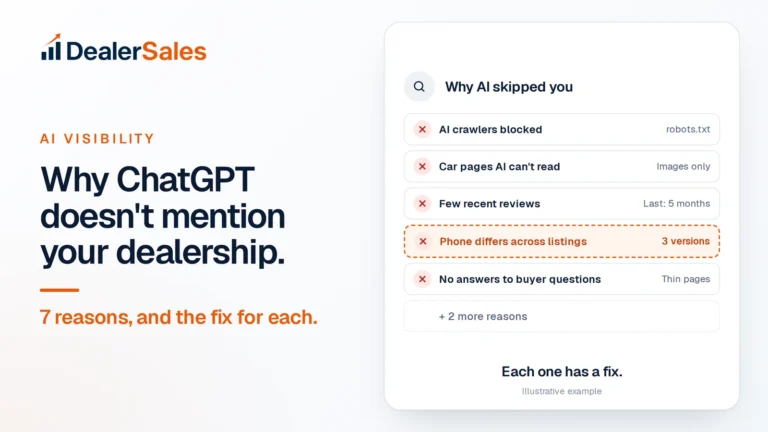
What moves the needle for ChatGPT: allow OAI-SearchBot, get indexed in Bing, and keep your details consistent across the sites it reads. More on that in why ChatGPT skips some dealerships.
Perplexity: live search with citations
Perplexity answers a question by searching the web live and showing numbered citations that link to the pages it used. That makes it the easiest of the four to audit: you can see exactly which sources won.
It runs two bots:
- PerplexityBot surfaces and links websites in Perplexity’s search results. Perplexity says it is not used to train AI models, and recommends allowing it in robots.txt.
- Perplexity-User visits a page when a user’s question needs it. Perplexity says it generally ignores robots.txt because a person asked for the page.
What moves the needle for Perplexity: let PerplexityBot in and publish pages that are worth citing. A page titled “Best used SUVs under $20,000 in [city]” with real cars and prices, like a 2018 Mazda CX-5 Touring at $18,490, gives it something to link.
Gemini: Google Search plus Google Maps
Google’s crawler documentation says content from the Google Search index is used for “grounding” in Gemini Apps, meaning it is handed to the model when someone asks a question. So if Google has indexed your pages, Gemini can draw on them.
For places, Google’s Gemini help page says Gemini uses public information from Google Maps to find businesses and give their addresses, descriptions, websites, ratings and opening hours. For a dealership, most of that comes from your Google Business Profile.
One trap: Google offers a robots.txt setting called Google-Extended. It controls whether your content may be used to train Gemini models and for grounding in Gemini Apps. Google says it does not affect Google Search. Block it by mistake and you may stay in Google Search but drop out of Gemini’s grounded answers.
The same foundations carry over to Google’s AI Overviews and AI Mode, which Google says need no special markup, just pages that are indexed and eligible to show a snippet. See how to get your dealership into Google AI Overviews.
What moves the needle for Gemini: a fully filled-in Google Business Profile, steady reviews, and indexed pages with plain-text facts.
Copilot: Bing search and Bing Places
Copilot is Microsoft’s assistant, and its web answers run on Bing. Bing Webmaster Tools now has an AI Performance report that shows when your pages are cited in Microsoft Copilot and in AI summaries in Bing, plus the phrases the AI used to retrieve them.
In the same announcement, Bing tells local businesses to register with Bing Places so their address, hours and contact details stay current and eligible for AI-generated responses.
Bing also recommends IndexNow, a way to tell Bing the moment a page is added or changed. For a dealer whose inventory turns every few weeks, that matters. A sold 2017 Jeep Wrangler Sport should drop out fast, and a newly listed one should show up fast.
What moves the needle for Copilot: Bing Webmaster Tools, a submitted sitemap, IndexNow if your platform supports it, and a claimed Bing Places listing.
The one fix that helps all four
Look at the table again. Every tool reads your website. That is the one asset you fully control, and it pays off four times.
A clear, crawlable dealer site means:
- robots.txt allows the search bots: Googlebot, Bingbot, OAI-SearchBot and PerplexityBot. Check Google-Extended is not blocked unless you mean it.
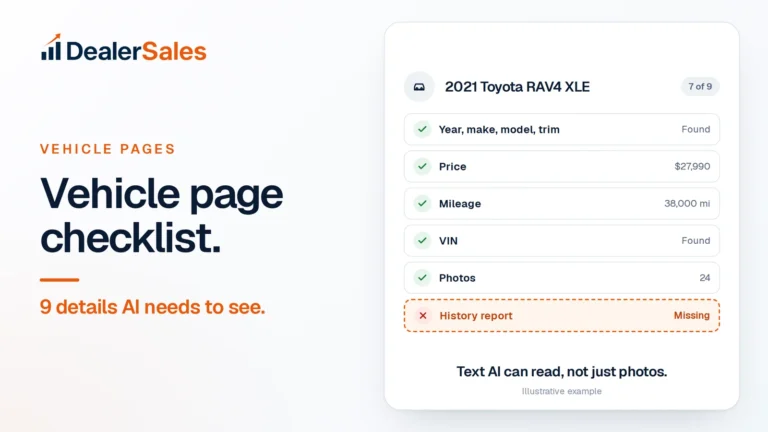
- Key facts are text, not images. Year, make, model, trim, price and mileage on every car page, readable without scripts. Many AI crawlers read only the raw page.
- Your homepage says who you are in one sentence: “Used car dealer in [city] with about 120 cars under $30,000 and in-house financing.”
- One page per common buyer question: bad credit, trade-ins, inspections, selling your car.
- The same name, address and phone number on your site, Google Business Profile, Bing Places and every listing.
This is the core idea behind every new acronym you are hearing. If GEO, AEO and AIO confuse you, here is how they fit together.
Which profiles to claim for which AI
| Profile | Helps most with | Time to set up |
|---|---|---|
| Google Business Profile | Gemini, Google AI Overviews and AI Mode | About 1 hour, plus verification |
| Bing Places | Copilot, and Bing results that ChatGPT’s search can draw on | About 30 minutes |
| Google Search Console | Getting pages indexed for Gemini and Google AI | About 30 minutes |
| Bing Webmaster Tools | Copilot and ChatGPT via Bing | About 30 minutes |
Australian dealers: the same four tools apply. Add Carsales to your consistency check alongside Google and Bing.
What to do next
Ask each of the four tools the same three buyer questions about your city and note who gets named and which pages get cited. If your store is missing from one tool but not the others, the table above tells you where to look first. Or let us run the full check across all four with the button below.
Quick answers
Does ChatGPT use Google or Bing?
OpenAI says ChatGPT uses third-party search providers and names Microsoft, which runs Bing, as one of them. It also runs its own crawler, OAI-SearchBot, so being readable matters as much as ranking.
Do I need a separate strategy for each AI?
Mostly no. All four read your website, so a clear, crawlable site does most of the work. The differences are the listings: Google Business Profile for Gemini, Bing Places for Copilot.
Which AI shows me where its answer came from?
Perplexity puts numbered citations on every answer. ChatGPT, Gemini and Copilot often show sources too, so click them to see which of your pages, if any, were used.
Sources
- Searching the web with ChatGPT (OpenAI Help Center)
- Perplexity crawlers (Perplexity)
- Google’s common crawlers: Google-Extended (Google Search Central)
- Find places and get directions in Gemini Apps (Google)
- Introducing AI Performance in Bing Webmaster Tools (Microsoft Bing)
Get my AI visibility score
We ask ChatGPT, Perplexity, Gemini and Google AI 20 buyer questions about your market and score how often you are named. Free, no sales call.