AI is rewriting the rules of automotive SEO — and most dealerships don’t even know it’s happening.
If you feel like your website traffic is dropping, Google clicks are slowing down, and shoppers seem to “skip” your website entirely…
you’re not imagining it.
This is the beginning of the zero-click automotive era, driven by generative AI systems like:
- Google AI Overviews
- ChatGPT Search
- Perplexity
- Gemini
- Bing Copilot
These systems answer the shopper directly, without requiring them to click through to your website… and they choose only a handful of sources to cite underneath their generated answer.
Those citations are the new digital real estate.
If your dealership isn’t cited, you’re invisible — even if you used to rank #1 in Google.
This guide breaks down exactly how car dealers can perform AI citation analysis, what to track, what to fix, and what to publish so that AI engines actually recommend your dealership.
You’ll also get:
- A repeatable framework
- A detailed, dealership-specific strategy
- Real examples
- A free citation tracking template
Let’s dive in.
Google introduced AI Overviews in 2024–2025 and the impact was immediate:
- Zero-click searches jumped to nearly 69%
- Organic traffic for many industries fell by 20–40%
- AI answer boxes replaced traditional search listings
- Dealerships that had ranked well for years suddenly disappeared
Meanwhile, AI chatbots like ChatGPT and Perplexity exploded in usage for:
- Car research
- Price comparisons
- Vehicle recommendations
- Dealer reviews
- Financing questions
- Service advice
Where people used to type:
“Best used SUVs under 20k near me”
They now ask:
“What SUV should I buy for under $20k?
Which dealers near me have good service ratings?
What truck is best for towing 5,000 lbs?”
And the AI answers directly.
This represents a tidal shift:
SEO is no longer just about Google ranking.
It’s about whether AI models cite you in the answers they generate.
An AI citation is the link shown beneath a generative answer, indicating where the AI pulled information from.
Example from a typical AI answer:
Q: “Which dealerships have the best reviews in Denver?”
AI Answer:
“Based on customer feedback, service quality, and local review data, the top dealerships in Denver are ABC Motors, Highline Auto, and Rocky Mountain Ford…”
Citations shown:
- Yelp.com/DenverAuto/Reviews
- ABCMotorsDenver.com
- DealerRater.com/Denver
If you’re not cited, you don’t exist in the shopper’s journey.
Traditional SEO:
→ Ranking #1 = visibility + clicks + leads
Generative SEO (GEO):
→ Being cited = visibility + trust + traffic
Citations act like AI’s version of:
- Backlinks
- References
- Recommendations
- Endorsements
AI engines decide:
- Which dealerships are trustworthy
- Which websites are accurate
- Which listings have the best data
- Which service centers are reliable
This is why AI citation analysis is now essential for dealership marketing.
Through studies (Yext, Similarweb, others), we now know:
86% of AI citations come from places dealers already control:
- 44% → The dealership’s website
- 42% → Business listings (GBP, Cars.com, Autotrader, CarGurus)
- 8% → Reviews and social content
- 2% → Forums and miscellaneous sites
Different AI engines prefer different sources:
Good news: You can influence almost all of these.
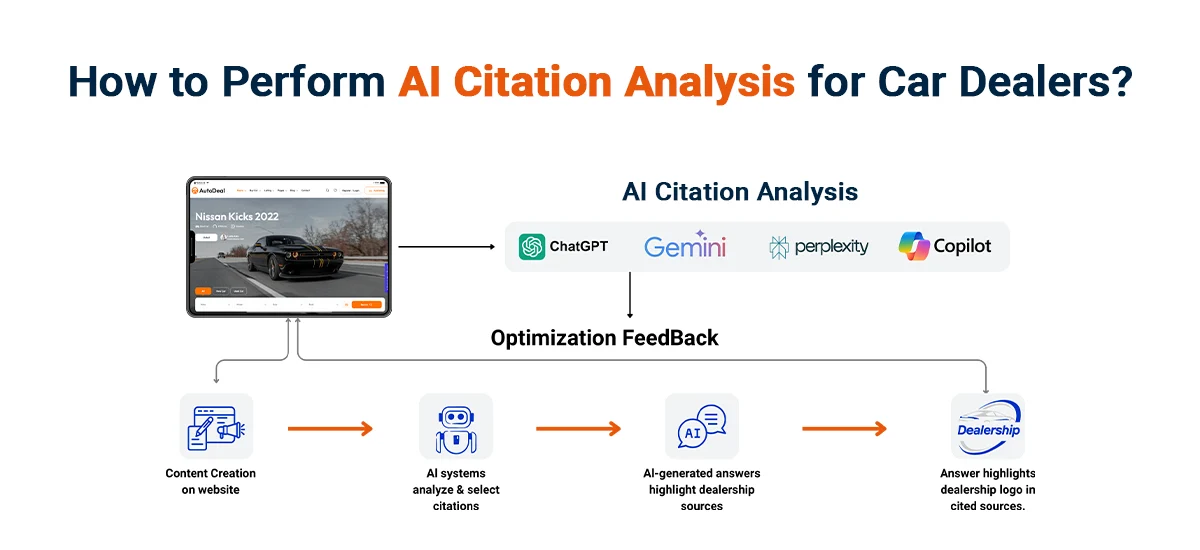
AI Citation Analysis =
A process that helps you see:
- Which AI engines mention your dealership
- Which engines ignore you
- Which competitors get cited instead of you
- Which pages on the internet (including your own) generate citations
- Which topics, keywords, and questions trigger citations
- Where you have citation gaps
- What content you need to create to fill those gaps
It’s the new version of SEO competitor research — but for AI generated answers instead of Google rankings.
Let’s walk through a dealer-specific framework you can run monthly.
For each rooftop, decide your priority focus areas:
Sales
- Used cars
- New inventory
- Certified pre-owned
- Trucks/SUVs
- Model comparisons
- “Best cars in X budget”
Service
- Oil changes
- Brake repair
- Transmission service
- EV maintenance
- Tire service
- Localized service guides
Finance
- Bad-credit financing
- First-time buyer programs
- Lease vs finance content
Then define:
Which questions should AI engines cite you for?
Examples:
- “Best Toyota dealer near me”
- “Used trucks under 20k in Miami”
- “Best place to service a Honda in Atlanta”
- “Which dealerships offer pickup & delivery?”
For each AI engine, record which sites it pulls citations from:
Common automotive citation sources:
- Your website
- Cars.com
- Autotrader
- CarGurus
- Google Business Profile
- DealerRater
- Local news
- OEM websites
- Local directories
- Yelp
- KBB
- Consumer Reports
- YouTube reviews
- Edmunds
Identify:
✔ Where you are present
✔ Where competitors appear
✔ Where you’re missing
This forms your citation gap analysis.
Citation gaps are points where:
- AI cites your competitor
- But does NOT cite you
- Even though the topic is relevant to your dealership
Example:
AI Answer:
“Best truck dealers in Dallas…”
Citations:
- DallasTruckCenter.com
- AutoNation Dallas
- CarGurus Trucks in Dallas
Your dealership? Missing.
Even though you sell trucks.
This is a pure citation gap.
We categorize gaps into 3 types:
1. Website content gaps
Example:
AI cites a competitor’s page on “Best SUVs for families”
→ You don’t have a page like that
2. Listing/review gaps
Example:
AI cites CarGurus or Cars.com listings
→ Your inventory isn’t detailed enough
→ Competitor listings look richer
3. Authority/content quality gaps
Example:
AI cites:
- Local news sites
- Dealer blogs with guides
- Comparison articles
→ You don’t have equivalent authoritative content
These gaps identify exactly what to fix next.
Once gaps are identified, take action in:
Website Content
AI likes:
- Detailed
- Structured
- Fact-heavy
- Model-specific
- Comparison-driven content
Add:
- “Best cars for…” guides
- “Model comparisons”
- “Local buyer guides”
- “Service explanations”
- “Pricing explanations”
AI loves neutral, objective information.
AI engines pull from:
- CarGurus
- Autotrader
- KBB
- Cars.com
Your inventory must be:
- Richly detailed
- Accurate
- Complete (full spec lists!)
- Photo-rich
- Consistent
If your competitor’s listings are better → AI will choose them.
AI Overviews heavily favors GBP.
You need:
- Complete services list
- Questions & Answers
- Review responses
- Photo updates
Dealership attributes (WiFi, EV chargers, hours, amenities)
AI engines interpret review tone as:
- Dealer trust
- Service reliability
- Customer satisfaction
You need:
- Continuous review generation
- Updated review velocity
- Balanced review response strategy
Track:
Visibility Metrics
- How often you’re cited
- In which AI engines
- In which topics
Traffic Metrics
- AI referral traffic (yes, it’s trackable!)
- Engagement behavior
Content Metrics
- What pages AI uses most
- Which pages never get cited
- Which pages competitors use
Gap Metrics
- New competitors appearing
- Lost citations
- Missing topics
- New opportunities
This becomes your AI visibility dashboard.
Let’s say we check Perplexity for:
“Best used SUV dealers in Tampa 2025”
Perplexity cites:
- AutoNation Tampa
- Cars.com Tampa SUVs
- Yelp’s top-rated Tampa dealers
Your dealership? Missing.
Root causes:
- Your inventory data is thin
- Your reviews are low or inconsistent
- You have no “used SUV” category content
- Cars.com listing quality is weak
- Local directories don’t mention you
Actions to win next time:
- Create a “Used SUVs in Tampa” page
- Add detailed SUV inventory listings
- Increase reviews
- Submit citations to Yelp and local news
- Improve Cars.com & CarGurus listings
Within 30–60 days, you can gain visibility and appear in new AI citations.